
If you search for the deepest gorges on planet Earth, the high Andes of southern Peru hold the crown. Slicing through the volcanic plateau of Arequipa, the Colca Canyon (Cañón del Colca) plummets to a staggering depth of 3,270 meters (10,725 feet).
That makes it more than twice as deep as the Grand Canyon in Arizona.
Most tourists experience Colca from the comfort of a tour bus window, standing at roadside lookouts on the upper rim before heading to a buffet restaurant.
But for true hikers, there is only one way to experience Colca: strapping on your daypack at the rim in Cabanaconde, plunging 1,200 vertical meters down into the rocky abyss to sleep in the tropical oasis of Sangalle, and climbing straight back up before dawn.
It is one of the most physically demanding, knee-testing, and deeply rewarding two-day treks in South America.
Here is the unfiltered guide to the trails, condors, temperatures, and physical realities of the Colca Canyon 2-Day Trek.
Day 1: Cruz del Cóndor & The 1,200-Meter Knee-Crushing Descent
Your expedition begins with an early morning departure from Arequipa at 3:00 AM, driving across the windswept high-altitude plateau of Pampa Cañahuas (3,800m), where herds of wild vicuñas graze alongside alpacas.
You cross Patapampa Pass at 4,910 meters (16,108 feet)—the highest point of the road—with steaming views of the active Sabancaya volcano puffing gray ash into the morning sky.
1. The Condor Flight at Cruz del Cóndor (8:00 AM – 9:30 AM)
Before hitting the trekking trail, you stop at the legendary cliffside viewpoint of Cruz del Cóndor.
- Here, the canyon walls drop 1,200 vertical meters straight down to the roaring Colca River.
- As the morning sun heats the rock faces, warm thermal air currents rise from the canyon floor.
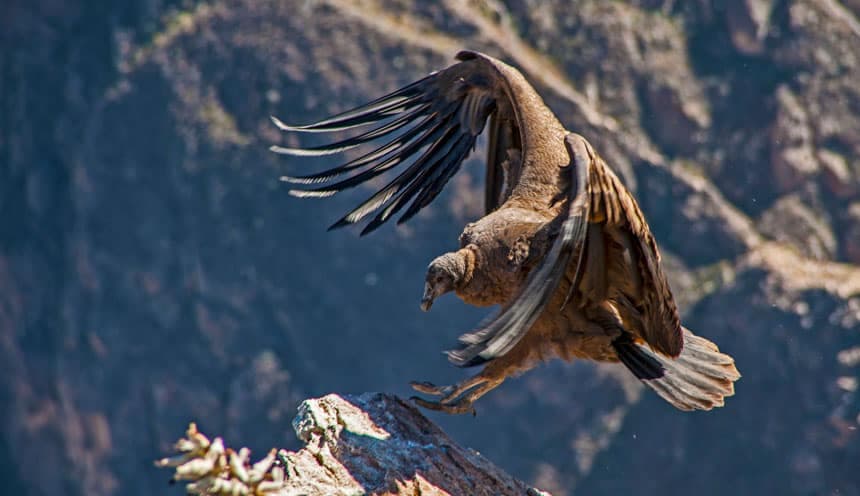
- Giant Andean Condors (Vultur gryphus)—with wingspans exceeding 3.0 meters (10 feet)—launch from their cliffside roosts, circling silently on thermal drafts just yards above your head without flapping their wings.
2. The 1,200m Descent: Cabanaconde to Sangalle (10:30 AM – 2:30 PM)
The trek begins at the village of Cabanaconde (3,287 m / 10,784 ft) at the canyon rim.
- The Distance: 6.2 kilometers.
- The Elevation Loss: -1,127 vertical meters down to the canyon floor (2,160 m / 7,086 ft).
- The Trail Surface: Extremely steep, dusty switchbacks covered in loose volcanic pebbles and round gravel.
- The Knee Impact: Every step forces your quadriceps to brake your downward momentum on a slippery 25-degree to 35-degree slope. Without dual trekking poles to absorb the shock, your knees will be trembling with fatigue within 90 minutes.
- The Temperature Shift: You begin at the rim in crisp mountain air (15°C / 59°F) and descend into a sweltering, arid microclimate (28°C / 82°F) at the canyon floor.
Sangalle Oasis: Palm Trees, Spring Pools & Rustic Huts
As you round the final canyon cliff corner, a surreal splash of vibrant emerald green appears on the canyon floor: The Oasis of Sangalle.
Fed by natural warm subterranean freshwater springs, Sangalle is a lush tropical sanctuary surrounded by vertical 3,000-foot rock walls:
- The Pools: Small eco-lodges feature open-air stone swimming pools filled with fresh spring water. Slipping into the cool pool after 4 hours of dusty, blistering descent is pure paradise.
- The Accommodation Reality: Lodges in Sangalle are rustic eco-bungalows built from bamboo and adobe. Rooms have basic twin beds with mosquito netting, shared cold-water bathrooms, and no heating. Electricity is generated by solar panels and typically operates for only 2 to 3 hours in the evening (6:00 PM to 9:00 PM).
- The Evening: You enjoy a simple, hearty dinner of vegetable soup, chicken, and rice by candlelight, listening to the roaring Colca River in the dark before an early bedtime.
Day 2: The 4:30 AM Vertical Wall Climb Out of the Canyon
This is the defining challenge of the trek.
There are no roads into Sangalle. The only way out is climbing the vertical stone wall back up to Cabanaconde.
The 4:30 AM Headlamp Ascent:
- Departure Time: 4:30 AM sharp. Climbing in the pitch blackness is essential; if you wait until the morning sun hits the canyon wall at 8:00 AM, the heat transforms the trail into an unbearable stone oven.
- The Challenge: +1,127 vertical meters UP in just 4.5 kilometers.
- The Gradient: Relentless, continuous uphill switchbacks with an average incline of 28% to 35%. There are zero flat resting sections.
- The Strategy: Switch on your headlamp, establish your rhythmic Paso de Chasqui breath, plant your trekking poles, and do not look up at the rim. Pace yourself steadily.
- Summit Time: In 2.5 to 3.5 hours, as the first rays of golden sunlight strike the canyon rim, you crest the final rocky ridge into Cabanaconde. The sense of physical triumph is exhilarating.
Trek Down into the Canyon vs. Upper Rim Bus Tour
Which Colca experience is right for you?
← Desliza horizontalmente para comparar columnas →
| Feature | Colca Canyon 2-Day Trek (Sangalle) 🥾 | Traditional Colca 2-Day Tour (Chivay Rim) 🚌 |
|---|---|---|
| Physical Difficulty | Very High (Strenuous knee & cardio demand) | Low (Gentle walking, bus lookouts) |
| Overnight Location | Deep inside canyon at Sangalle Oasis (2,160m) | Historic colonial village of Chivay or Yanque (3,630m) |
| Hotel Comfort | Rustic bamboo bungalows, basic amenities | 4 & 5-star hotels (Colca Lodge, Belmond Las Casitas) |
| Condor Sightings | Yes (At Cruz del Cóndor) | Yes (At Cruz del Cóndor) |
| Hiking Distance | 11 km total (1,200m down, 1,200m up) | 1 to 2 km of flat scenic walking |
| Best Suited For | Fit hikers, backpackers & adventurers | Families, seniors & luxury travelers |
Essential Gear: Trekking Poles, Headlamps & Dust Gaiters
- Dual Trekking Poles: Non-negotiable. Without poles, the downhill descent will destroy your knees, and the 4:30 AM ascent will burn out your quads.
- High-Lumen Headlamp: For the pre-dawn climb on Day 2. Bring fresh batteries.
- Electrolyte Powder Packets: You will sweat heavily on both the descent and ascent in the dry canyon heat. Water alone will leave you with debilitating calf cramps.
- Trail Dust Protection: Fine volcanic dust rises with every step. Wear high socks or trail gaiters, and pack a bandana or buff to cover your mouth.
- Cash in Soles: S/ 70 for the Colca Tourist Ticket, plus small bills for bottled water and cold drinks at the oasis.
Frequently Asked Questions (FAQ)
Can I continue directly from Colca to Puno (Lake Titicaca)?
Yes! This is one of the most efficient travel routes in southern Peru. After climbing out of the canyon and soaking in the thermal baths in Chivay, you can board the 4M Express tourist coach directly to Puno (departing at 1:15 PM, arriving in Puno at 7:00 PM), saving you from having to backtrack to Arequipa!
What are the thermal baths like?
The Chacapi Hot Springs in Yanque feature multiple natural stone outdoor pools sitting right beside the rushing river, heated to a relaxing 38°C to 40°C (100°F to 104°F) by volcanic subterranean springs. Entry costs only S/ 15.00 Soles ($4 USD).
What happens if I get injured in the canyon?
Local horse wranglers are stationed in Sangalle. If a hiker sprains an ankle or suffers severe exhaustion, a mule can be hired to carry the passenger up the canyon switchbacks to Cabanaconde.
Local Team Advice: Rodrigo's Colca Trail Rule
As our Official Mountain Guide Rodrigo notes:
"The Colca Canyon will test every muscle in your legs. When you look up from the bottom of Sangalle at that 3,000-foot vertical rock wall and realize you have to climb it in the dark tomorrow morning, your stomach will flutter. But when you stand at the rim at sunrise with the wind in your face and a hot cup of coffee in your hands, you will know what your body is truly capable of."