
The 3:00 AM Trap: What Budget 1-Day Tours Hide About Colca
Walk through the historic center of Arequipa along Calle Santa Catalina or Calle Jerusalén, and you will see dozens of travel agency chalkboards advertising: "Colca Canyon Full Day – Only $35 USD! Daily Departures!"
To the unsuspecting traveler with limited vacation days, it sounds like an irresistible bargain: see the deepest canyon in the world, watch wild Andean condors soar, and sleep back in your Arequipa hotel bed the same night.
What those chalkboards and budget online travel agencies (OTAs) fail to mention is the brutal physical reality of the itinerary:
- The 2:30 AM Wakeup Alarm: Your hotel pickup window starts between 2:45 AM and 3:30 AM. You stumble into an 18-passenger minibus in pitch darkness, shivering in the cold Arequipa morning air.
- 11+ Hours Seated in a Minibus: The distance between Arequipa and Cruz del Cóndor is roughly 180 km (112 miles) each way along twisting, high-altitude Andean mountain roads. You will spend over 11 hours bouncing on a bus seat.
- The Dark Altitude Shock: At 5:30 AM, while you are trying to sleep, the bus ascends to Patapampa Pass at 4,910 m (16,109 ft). At that altitude, atmospheric oxygen pressure is 45% lower than at sea level. Travelers routinely wake up gasping for air, violently nauseous from acute mountain sickness (soroche).
- Barely 45 Minutes at the Canyon Rim: By the time you reach the Cruz del Cóndor viewpoint around 8:45 AM, you are physically exhausted, sleep-deprived, and sharing the viewpoint with 40 other budget tour buses. After 45 to 60 frantic minutes of snapping photos, your driver is honking the horn to herd everyone back for the grueling 5-hour drive back to Arequipa.
By 5:30 PM, when the minibus drops you off near Plaza de Armas, you haven't experienced the Colca Valley—you have survived an endurance marathon.
Here is our frank, on-the-ground guide on why taking the Colca Canyon 2-Day/1-Night Classic Excursion transforms a grueling survival test into one of the most serene, culturally rich, and breathtaking highlights of your journey through Southern Peru.
At-a-Glance: Colca 2-Day/1-Night vs. 1-Day Full Day Sprint
| Dimension | Colca Canyon 2-Day/1-Night Classic | Colca Canyon 1-Day Full-Day Sprint |
|---|---|---|
| Arequipa Hotel Pickup | 8:00 AM (unhurried breakfast & rest) | 2:45 AM – 3:15 AM (brutal sleep deprivation) |
| Total Van Transit Time | 4 hours Day 1 / 4.5 hours Day 2 (relaxed stops) | 11 to 12 hours continuous driving in one day |
| Crossing Patapampa Pass (4,910 m) | 11:30 AM in bright sunshine (active volcanoes visible) | 5:30 AM in pitch black (-5°C / 23°F, high soroche risk) |
| Wildlife at Pampa Cañahuas | Daytime stop to observe wild vicuñas, alpacas & vizcachas | Passed in total darkness; invisible from bus windows |
| Time at Cruz del Cóndor | 2 to 2.5 unhurried hours during prime morning updrafts | 45 to 60 rushed minutes surrounded by crowds |
| Volcanic Hot Springs Soak | Yes (La Calera thermal baths, 38°C / 100°F) | No (or a rushed 20-minute dip under strict timer) |
| Overnight Cultural Stay | Yes (peaceful eco-lodge in Chivay or Yanque) | None (return to Arequipa by dusk exhausted) |
| Connection to Puno (Lake Titicaca) | Direct 1:15 PM transfer from Chivay (saves 1 full day!) | Impossible (forces backtracking 4.5 hrs to Arequipa) |
| Physical & Mental Exhaustion | Low / Restorative (2/5 difficulty) | Punishing / Extreme (5/5 exhaustion) |
The Patapampa Pass Shock: Ascending to 4,910 m (16,109 ft) in the Dark
To understand why the 1-day tour triggers acute mountain sickness (soroche) in so many travelers, you must understand the topographic cross-section of the Arequipa-to-Colca route:
- Arequipa sits in a temperate valley at 2,325 m (7,628 ft).
- The road climbs relentlessly past the foothills of Misti and Chachani volcanoes into the Pampa Cañahuas vicuña reserve at 3,800 m (12,467 ft).
- The road peaks at the windswept continental divide: Patapampa Volcano Viewpoint at 4,910 m (16,109 ft).
- It then plunges downward into the agricultural floor of the Colca Valley at Chivay (3,635 m / 11,925 ft).
On the 1-day budget tour, you make this massive vertical jump of 2,585 meters (8,481 vertical feet) in under 3.5 hours while your body is asleep. The sudden drop in barometric pressure causes blood oxygen saturation (SpO2) to plummet from 96% down to 72%–78%. Waking up at 4,900 meters in zero-degree weather without gradual acclimatization causes throbbing headaches, dizziness, and intense nausea.
On our Colca Canyon 2-Day Excursion, the dynamic is completely inverted:
- You depart Arequipa at 8:00 AM, fully rested with a hot breakfast in your stomach.
- Your first stop is at Pampa Cañahuas (3,800 m) to drink fresh mate de coca (coca tea) or muña (Andean mint) and photograph protected wild vicuñas grazing in their natural habitat.
- You cross Patapampa Pass around 11:30 AM when the sun is high and warm. You step out onto the volcanic rock plateau to witness the smoking crater of active volcano Sabancaya, alongside the glaciated peaks of Ampato (6,288 m / 20,630 ft) and Hualca Hualca.
- Within 45 minutes, you descend safely into Chivay (3,635 m) to check into your room, hydrate, and relax. Your body handles the elevation naturally with zero panic.
The Science of Cruz del Cóndor: Why Condors Fly from 8:00 to 10:00 AM
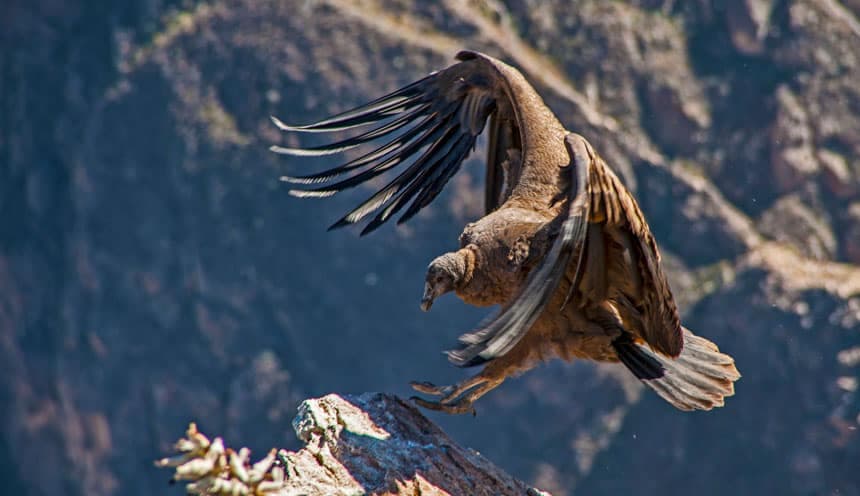
The centerpiece of any Colca journey is standing on the cliffs of Cruz del Cóndor, peering 1,200 meters (3,937 feet) straight down to the rushing Colca River, while wild Andean condors (Vultur gryphus) glide past at eye level.
Many travelers mistakenly believe that condors are always flying throughout the day. They are not.
Here is the aerodynamic physics of condor flight:
- An adult Andean condor weighs up to 15 kg (33 lbs) with a wingspan of 3.2 meters (10.5 feet). They are the heaviest flying raptors on Earth.
- Because of their immense weight, flapping their wings for sustained periods consumes an unsustainable amount of metabolic energy in thin high-altitude air.
- Instead, condors rely almost entirely on thermal updrafts—rising columns of warm air generated when the morning sun heats the dark volcanic canyon rock faces.
Around 7:30 AM, the sun begins illuminating the sheer rock walls of the Colca Canyon. By 8:15 AM, these thermal columns become powerful enough to lift a 30-pound bird effortlessly. The condors launch from their nesting ledges deep in the abyss and circle upward in sweeping, majestic spirals without flapping a single feather.
By 10:30 AM to 11:00 AM, as the canyon floor warms completely and the temperature gradient equalizes, the thermal elevator dissipates. The condors gain immense altitude and drift far out into the high Altiplano to hunt for carrion, disappearing from sight until late afternoon.
On a 1-day tour, any minor delay—a flat tire, traffic at the Chivay police checkpoint, or slow breakfast—means you arrive at Cruz del Cóndor at 9:30 AM or 10:00 AM, right as the condors are leaving. On the 2-day tour, your lodge in Chivay or Yanque is only 45 minutes away. You arrive at Cruz del Cóndor by 8:00 AM, securing the best vantage point along the cliffside trail long before the day-trip buses arrive.
The Hidden Value of the Night: Hot Springs, Wititi Dancers & Stargazing
The Colca Valley is not merely a geological crack in the Earth; it is a living cultural sanctuary inhabited by the Collagua and Cabana indigenous peoples for over two millennia.
Taking the 2-day journey unlocks experiences that are physically impossible on a rushed day tour:
- La Calera Volcanic Thermal Springs: After descending from Patapampa Pass on Day 1, you spend the afternoon soaking in natural outdoor mineral pools heated to 38°C (100°F) by subterranean volcanic magma. The rich sulfur, calcium, and iron content soothes tired muscles and opens respiratory airways.
- Pre-Inca Stepped Terraces (Andenes): More agricultural terraces are farmed in the Colca Valley today than during Incan times. From your lodge in Yanque or Chivay, you can walk among working stone aqueducts fed by glacier meltwater, surrounded by fields of native quinoa, fava beans, and purple corn.
- The Wititi Dance (UNESCO Cultural Heritage): In the evening, traditional local restaurants in Chivay host live Andean music performances showcasing the Wititi—a vibrant courtship dance born in the Colca Valley where male dancers wear colorful women's skirts and embroidered monteras to disguise themselves while serenading their partners.
- Altiplano Stargazing: Away from city light pollution, the Colca Valley night sky is astonishing. The Milky Way (Mayu, the cosmic celestial river) arcs across the jagged canyon rims, displaying the Southern Cross (Cruz del Sur) and the dark constellations of the Llama and the Condor.
The Logistical Secret: Connecting Directly from Colca to Lake Titicaca
This is the single most valuable logistical secret for anyone planning a grand tour of Peru: Chivay is geographically located halfway between Arequipa and Puno (Lake Titicaca).
Consider the two routing options:
Option A: The Exhausting Backtracking Route (What 1-Day Tours Force You to Do)
- Day 1: 2:45 AM wakeup, 12 hours driving to Colca and back to Arequipa. Arrive in Arequipa at 5:30 PM exhausted.
- Day 2: Wake up early in Arequipa, take an 11-hour tourist bus or a costly connecting flight via Lima to Juliaca/Puno.
- Total travel time lost: Over 23 hours across two full days sitting in transit.
Option B: The Daspe Travel Overland Connection (The Smart Traveler Route)
- Day 1: Depart Arequipa at 8:00 AM. Cross Patapampa in daylight. Soak in La Calera hot springs. Sleep in Chivay.
- Day 2: Watch condors at Cruz del Cóndor from 8:00 to 10:30 AM. Return to Chivay for a buffet lunch.
- 1:15 PM: Board our comfortable 4M-Express tourist coach or private Mercedes van directly from Chivay across the high Altiplano to Puno.
- Along the route to Puno, you make scenic photo stops at Lagunillas Lake (4,413 m / 14,478 ft) to watch wild Andean flamingos (parihuanas) wading in the icy blue water.
- 7:00 PM: Arrive directly at your hotel in Puno on the shores of Lake Titicaca.
By choosing the 2-day tour with the Puno connection, you save an entire full vacation day, eliminate 6 hours of unnecessary backtracking, and avoid an extra hotel night in Arequipa.
Ground Friction & Money: Cash-Only Boleto Turístico (BTC) and Baños
A key reason travelers leave bad reviews for budget Colca tours is surprise cash expenses that agencies conceal until the minibus is already 3 hours into the mountains.
Here is the exact ground reality of cash requirements in the Colca Valley:
- The Mandatory Colca Tourist Ticket (BTC - Boleto Turístico del Colca):
- International Foreign Travelers: S/ 70 PEN (~$19 USD) per person.
- South American (CAN) Travelers: S/ 40 PEN (~$11 USD) per person.
- Peruvian Citizens: S/ 20 PEN (~$5.50 USD) per person.
- Critical Notice: The AUTOCOLCA regulatory checkpoint at the entrance of the valley operates on a 100% physical cash-only basis in Peruvian Soles. Credit cards, US Dollars, and digital payments (Yape/Plin) are strictly rejected due to zero cellular connectivity. If you do not have physical Soles in your wallet, you will be barred from entering the canyon.
- La Calera Hot Springs Admission: S/ 15 PEN (~$4 USD) cash per person. Locker rentals are an additional S/ 3 Soles.
- Community Restrooms along the Route: In village stops like Maca and Yanque, community restrooms charge S/ 1.00 or S/ 2.00 Soles in coins. Always carry a small pouch of 1-sol and 2-sol coins in your daypack.
- Buffet Lunches in Chivay: Traditional Andean buffet restaurants in Chivay cost between S/ 35 and S/ 50 PEN (~$10–$14 USD). While some accept Visa/Mastercard, internet connection drops are frequent, making cash significantly faster.
- ATMs in Chivay: There are only two bank ATMs (BCP and Banco de la Nación) in Chivay. During peak travel months (May through September), they frequently run out of cash by Saturday afternoon. Always withdraw at least S/ 200 Soles per person from an ATM in Arequipa before your departure.
The Guide's Honest Verdict: When is 1-Day Acceptable vs. Why 2-Day is Essential
As collegiate guides licensed by DIRCETUR, our mission at Daspe Travel is not to push the most expensive tour—it is to give you the honest truth so your body and mind can truly absorb the majesty of the Andes.
Choose the 1-Day Full Day Tour ONLY IF:
- You have a rigid, unextendable flight departing Arequipa that evening and zero additional vacation days.
- You have already spent at least 4 to 5 days acclimatizing in Cusco (3,400m) or Lake Titicaca (3,812m), meaning the 4,910m Patapampa pass will not trigger altitude shock.
- You have the stamina to endure 11+ hours of minibus transit on 3 hours of fragmented sleep.
Choose the Colca Canyon 2-Day/1-Night Classic Excursion IF:
- You value your physical well-being, want a full night's sleep, and wish to cross Patapampa Pass in glorious midday sunlight with views of smoking volcanoes.
- You want a front-row seat at Cruz del Cóndor from 8:00 AM when the morning thermal updrafts launch the condors right above your head.
- You want to soak in the volcanic thermal waters of La Calera, stroll through pre-Inca terraces, and experience authentic Collagua culture.
- You are continuing your journey to Lake Titicaca (Puno) and want to save a full travel day by connecting overland across the Altiplano.