
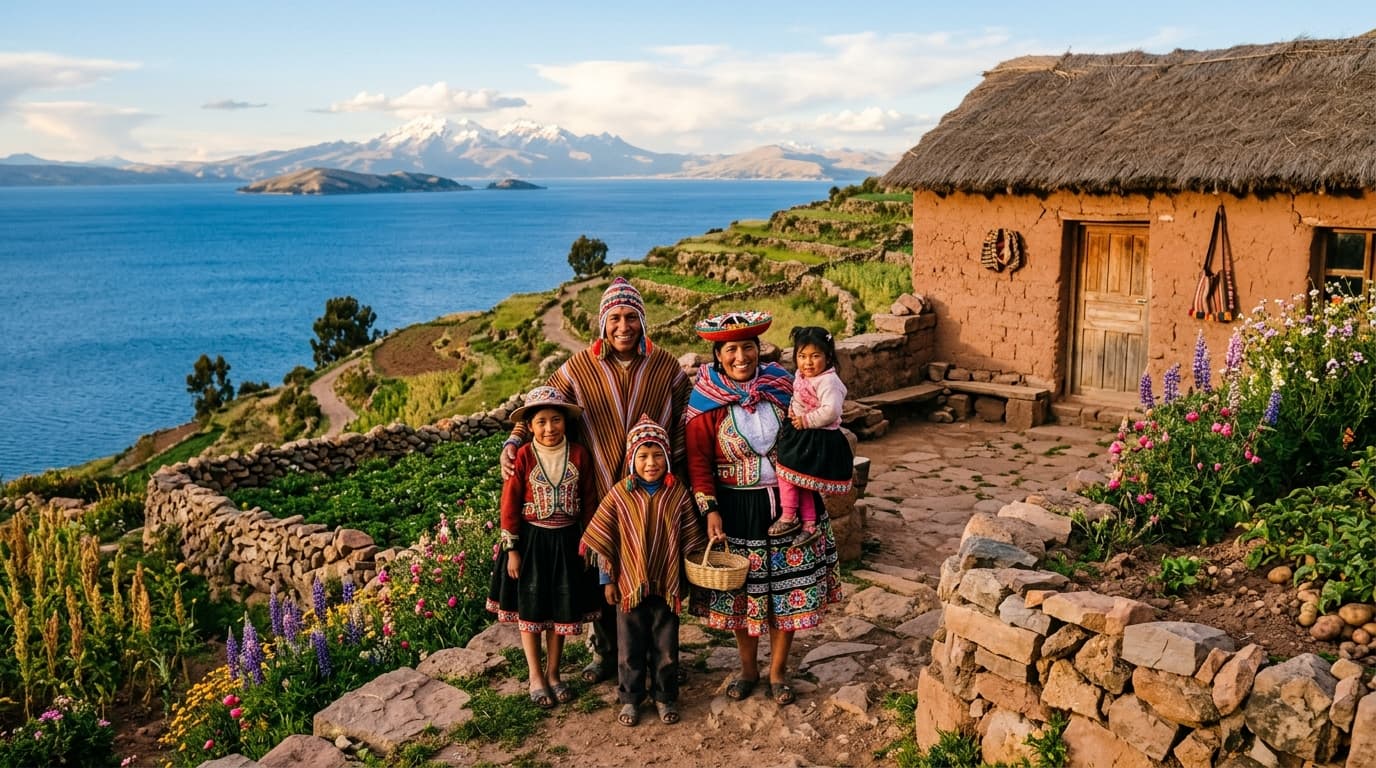
Perched high in the Altiplano basin between southern Peru and Bolivia, Lake Titicaca is the highest navigable body of water on the planet. For the ancient Incan civilization, this cobalt-blue alpine sea was nothing less than the birthplace of the cosmos—where the Sun God Inti commanded Manco Cápac and Mama Ocllo to rise from the waters to establish the imperial capital of Cusco.
Yet for modern international travelers, Lake Titicaca presents a polarized reputation. Travel forums overflow with complaints about staged commercial interactions on the Uros reed islands, agonizingly slow wooden transport boats, and biting sub-zero nighttime temperatures.
The reality is that Lake Titicaca is extraordinary when experienced with authentic community connections, proper boat logistics, and realistic expectations regarding high-altitude living.
Here is the unvarnished guide from our licensed Altiplano team to help you navigate Uros, Taquile, and Amantaní.
The 12,500 ft Reality: Why Lake Titicaca Hits Harder than Cusco
The single most common mistake made by travelers is assuming that because Lake Titicaca is a lake, it must sit in a low-lying valley.
In reality, Lake Titicaca sits at 12,507 ft (3,812 m) above sea level. That is 1,350 feet (412 meters) HIGHER than Cusco (11,150 ft / 3,400 m) and over 4,500 feet higher than Machu Picchu (7,972 ft / 2,430 m).
- Effective Atmospheric Oxygen: The air contains roughly 38% less effective oxygen than at sea level.
- The Taquile Staircase Reality: On Taquile Island, there are no roads, cars, or pack animals. To reach the village square from the boat dock, hikers must ascend 530 ancient stone steps from 3,812 m up to 3,950 m (12,960 ft). If you have not acclimatized in Cusco or Arequipa first, this climb will leave you severely winded.
- Guide Rule: Never schedule Lake Titicaca as your very first stop in Peru immediately after landing in Lima. Visit the Sacred Valley or Cusco first, or ascend gradually through the Colca Canyon from Arequipa.
Quick Island Comparison: Uros vs. Taquile vs. Amantaní
Each of the three primary islands in the Peruvian sector of Lake Titicaca represents a completely distinct indigenous culture, language, and operational experience:
| Feature | Uros Floating Islands | Taquile Island | Amantaní Island |
|---|---|---|---|
| Language Spoken | Aymara & Spanish | Quechua & Spanish | Quechua & Spanish |
| Island Construction | Man-made floating totora reed blocks (khili) | Natural granite rock island | Natural granite & sandstone island |
| Maximum Elevation | 12,507 ft (3,812 m) (Water level) | 13,000 ft (3,960 m) | 13,550 ft (4,130 m) (Pachatata temple) |
| Transit Time (Speedboat) | 20 minutes from Puno | 1 hr 15 min from Puno | 1 hr 30 min from Puno |
| Transit Time (Slow Boat) | 40 minutes from Puno | 3.5 hours from Puno | 4 hours from Puno |
| Primary Cultural Feature | Floating engineering & reed reed-boat crafting | UNESCO World Heritage male textile knitters | Authentic family homestays & Pachamama sunset |
| Ideal Trip Duration | 1.5-hour cultural demonstration | Half-day hike & traditional trout lunch | Full overnight 2D/1N cultural homestay |
The Uros Floating Islands: Cultural Survival vs. Commercialism
Travelers frequently ask: "Are the Uros floating islands real, or are they just a theme park for tourists?"
The historical answer is fascinating:
- Ancestral Origin: The original Uros people were a distinct pre-Incan ethnic group. When aggressive Incan armies expanded into the Altiplano, the Uros built floating villages out into the lake shallows to escape servitude and military capture. If threatened, they simply untied their reed anchors and floated their entire community away.
- The Engineering: The islands are constructed from dense root blocks of native totora reeds (khili) harvested from the lakebed, bundled together with eucalyptus stakes and ropes. New layers of freshly cut totora reeds must be laid across the surface every 15 to 20 days as the bottom layers slowly decay in the 50°F (10°C) water.
- The Modern Commercial Friction: Today, approximately 100 floating islands exist in Puno bay, housing roughly 2,000 residents. Mass-market budget tours shepherd 50 people onto tiny reed islands where resident families perform songs in 5 languages and aggressively urge visitors to buy mass-produced tapestries.
- How We Do It Differently: Our guided Lake Titicaca Speedboat Full Day: Uros & Taquile visits cooperative family islands during early morning hours before the budget flotillas arrive. You sit down with the village elder (presidente de la isla) to cut totora reeds, taste the edible inner reed stalk (chullo), and inspect the anchoring mechanics without commercial pressure.
Taquile Island: UNESCO Masterpiece of Male Weavers
While Uros is famous for its floating ground, Taquile Island is famous for the extraordinary social fabric of its inhabitants. In 2005, the textile art of Taquile was proclaimed a Masterpiece of the Oral and Intangible Heritage of Humanity by UNESCO.
What makes Taquile unique in the Andean world:
- The Men Do the Knitting: While women spin alpaca and sheep wool and weave broad cloths on ground looms, the world-renowned knitwear is created exclusively by the men, beginning in childhood at age 7 or 8.
- The Chullo as Social ID: The knitted wool cap (chullo) worn by Taquile men communicates their exact marital, social, and political status. A cap with a white crown indicates an unmarried man; an all-red embroidered chullo indicates a married man; and intricate multi-colored designs signify community elders (autoridades).
- No Police, No Dogs, No Cars: Taquile operates under strict traditional community collectivism based on the Incan moral code: Ama sua, ama llulla, ama quella (Do not steal, do not lie, do not be lazy). There are zero stray dogs, zero private motor vehicles, and zero police officers.
- The Traditional Lunch: A visit to Taquile includes a freshly prepared meal of lake-harvested trout (trucha a la plancha), locally grown native potatoes, quinoa vegetable soup, and digestive Muña (Andean mint) tea, served overlooking the deep sapphire waters with the snow-capped Bolivian Cordillera Real visible on the horizon.
Amantaní Island: What a Real Indigenous Homestay is Actually Like
For travelers seeking profound cultural connection rather than a quick photo stop, taking our Amantaní Island Homestay 2 Days & 1 Night Tour is transformative. However, you must arrive with realistic expectations about rural Andean life:
- Rotational Family Hosting: Homestays are managed by the community's agricultural cooperative. When the boat arrives, the island leader assigns visitors to host families on a strict rotating basis so every household shares in the economic benefit.
- The Living Conditions: You are staying in a real Quechua family home constructed of thick sun-dried adobe bricks. Floors are often clean hardwood or polished stone. Beds are furnished with multiple heavy, hand-woven sheep and alpaca blankets that keep you warm despite the lack of central heating.
- The Food: Meals are cooked over wood stoves using ingredients grown directly on the island: quinoa vegetable soup, fried cheese (queso frito), boiled potatoes, sweet corn, and fried eggs. If you require gluten-free or vegetarian meals, the families accommodate naturally.
- The Sunset Pilgrimage: In the late afternoon, your host family guides you up to the island's twin sacred peaks: Pachatata (Father Earth) and Pachamama (Mother Earth) at 13,550 ft (4,130 m). Watching the sun set across Lake Titicaca while Andean lightning illuminates distant Bolivian storm clouds is an unforgettable spiritual experience.
- Homestay Etiquette: Never hand out candies or chocolates to island children. Dental care on Amantaní is virtually nonexistent. If you wish to bring gifts to your host family, purchase staples at the central market in Puno before departing: 2-liter bottles of cooking oil, bags of rice, oatmeal, or fresh fruit (apples, oranges, bananas) which cannot grow at this extreme altitude.
Speedboat vs. Slow Boat: The 4-Hour Time Difference
The single biggest logistical trap on Lake Titicaca is booking a "cheap" tour that relies on traditional wooden fishing boats (lanchas tradicionales).
| Transport Feature | Licensed Fast Speedboat (Daspe Travel) | Traditional Wooden Slow Boat |
|---|---|---|
| Engine Configuration | Twin 200–250 HP Yamaha 4-stroke marine outboards | Single rebuilt tractor diesel engine |
| Puno to Taquile Transit | 1 hour 15 minutes | 3.5 hours |
| Puno to Amantaní Transit | 1 hour 30 minutes | 4 hours |
| Cabin Comfort | Padded high-back seats, indoor cabin, panoramic windows | Wooden benches, cold open-air draft, loud engine vibration |
| Exhaust Fumes | Clean, odorless modern 4-stroke emission standards | Heavy diesel soot and nauseating exhaust fumes |
| Time Spent on Islands | 5+ hours of cultural exploration and relaxed dining | Less than 90 minutes rushed across the island |
Spending 7 hours in a freezing, loud wooden boat just to visit Taquile for 75 minutes is the #1 reason travelers leave Lake Titicaca disappointed. Our private and small-group speedboat services give you the speed, safety, and comfort required to truly savor this alpine wonder.
The Altiplano Field Verdict: Which Itinerary Should You Choose?
- Choose the Speedboat Full-Day Tour (Uros & Taquile) IF: You have limited travel days, are in Puno for 1 or 2 nights, and want to experience both the floating reed engineering of Uros and the UNESCO male knitters of Taquile without exhausting yourself or enduring sub-zero unheated rooms.
- Choose the 2D/1N Amantaní Homestay IF: You seek genuine human connection, wish to disconnect completely from WiFi and hotel luxury, are eager to participate in ancestral agricultural rhythms, and want to witness the magical sunset over Pachatata temple.
Planning your journey to the world's highest lake? Connect directly with our Cusco and Puno operations desk via WhatsApp to coordinate high-speed boat departures, private lake transfers, and luxury PeruRail train connections across the Altiplano.